
How to Read a Coffee Bag Label: Roast Date, Origin and Tasting Notes
Introduction How to read a coffee bag label starts with three simple questions. Is the coffee fresh? Will you enjoy the flavour? Is the bag worth the price? Coffee packaging often answers all three, although you sometimes need a magnifying glass and the patience of a saint. Start with the roast date, roast level, tasting…
Table of Contents
Introduction
How to read a coffee bag label starts with three simple questions. Is the coffee fresh? Will you enjoy the flavour? Is the bag worth the price?
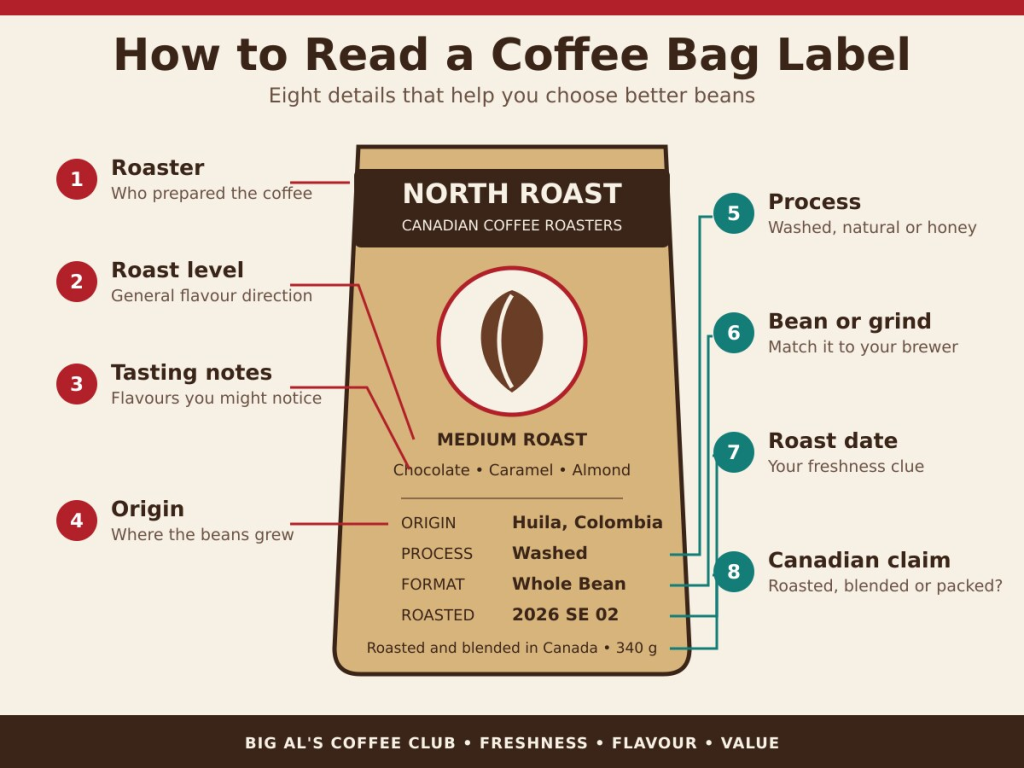
Coffee packaging often answers all three, although you sometimes need a magnifying glass and the patience of a saint. Start with the roast date, roast level, tasting notes, origin and grind. Canadian shoppers should also check whether the coffee was roasted here or merely packaged here.
Once you know how to read a coffee bag label, choosing beans becomes less of a gamble. You need enough information to avoid spending good money on a disappointing cup.
Coffee Bag Label Quick Guide
| Check this | What it tells you | Priority |
|---|---|---|
| Roast date | When the beans were roasted | Check first |
| Roast level | Light, medium or dark flavour direction | High |
| Tasting notes | Flavours and aromas you might notice | High |
| Origin | Where the beans were grown | High |
| Process | How the coffee fruit was removed and dried | Medium |
| Whole bean or ground | Whether the coffee suits your equipment | Essential |
| Canadian wording | Where roasting, blending or packaging happened | High |
| Bag weight | The true value for your money | High |
How to Read a Coffee Bag Label for Freshness
The coffee roast date tells you when green beans became roasted coffee. It gives you a clearer freshness clue than a distant best-before date.
Coffee does not reach a magic peak on one universal day. Roast level, packaging, storage and brewing method affect how flavour develops. Many Canadian roasters suggest a short rest followed by several weeks of enjoyable brewing. Calgary-based Fratello Coffee Roasters and Edmonton-based Rogue Wave Coffee treat the roast date as useful buying information.
Buy an amount you will finish while the coffee still tastes lively. A large bag is no bargain if the last third tastes like warm brown water. People living alone often get better value from a smaller bag, even when the price per gram is higher.
Coffee Roast Date vs Best-Before Date
A roast date records when the beans were roasted. A best-before date estimates how long an unopened product should retain its quality when stored properly.
The Canadian Food Inspection Agency states that best-before dates concern freshness and quality, not food safety. Foods with a shelf life longer than 90 days generally do not require one, although manufacturers often add one voluntarily. Health Canada also distinguishes best-before dates from expiration dates.
No roast date does not prove the coffee is poor. It simply leaves you with less evidence about freshness. For premium-priced beans, I want more than elegant lettering and a promise of “gourmet richness.”
What the Coffee Origin Label Tells You
Origin might identify a country, region, farm, estate or cooperative. More detail provides better traceability, but extra detail does not guarantee you will enjoy the coffee.
Single-origin coffee comes from one defined place. A blend combines origins. Single origins often highlight regional characteristics. Blends aim for balance and consistency. Neither is automatically better.
Origin offers a starting point rather than a flavour guarantee. Growing conditions, variety, processing, roasting and brewing all influence your cup. For a closer look at the journey, read Where Do Canadian Coffee Roasters Get Their Beans?.
What Does “Roasted in Canada” Mean?
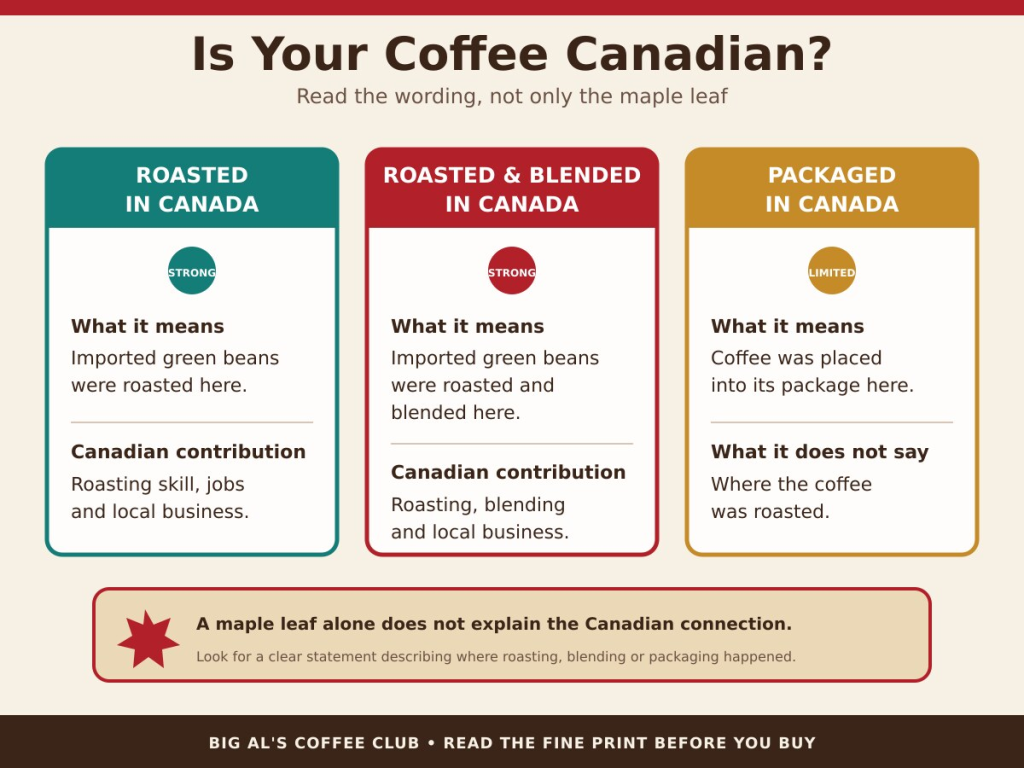
Canada imports green coffee beans, then Canadian businesses roast, blend or package them here. “Roasted in Canada” describes Canadian work and expertise, not where the coffee plant grew.
The CFIA’s origin-claims guidance lists “roasted and blended in Canada” as suitable wording for coffee made with imported beans. “Packaged in Canada” only identifies the packaging step. A maple leaf looks cheerful, but it does not explain the Canadian connection.
My guide to what Canadian-roasted coffee means explains this distinction in greater detail.
How to Read Coffee Tasting Notes
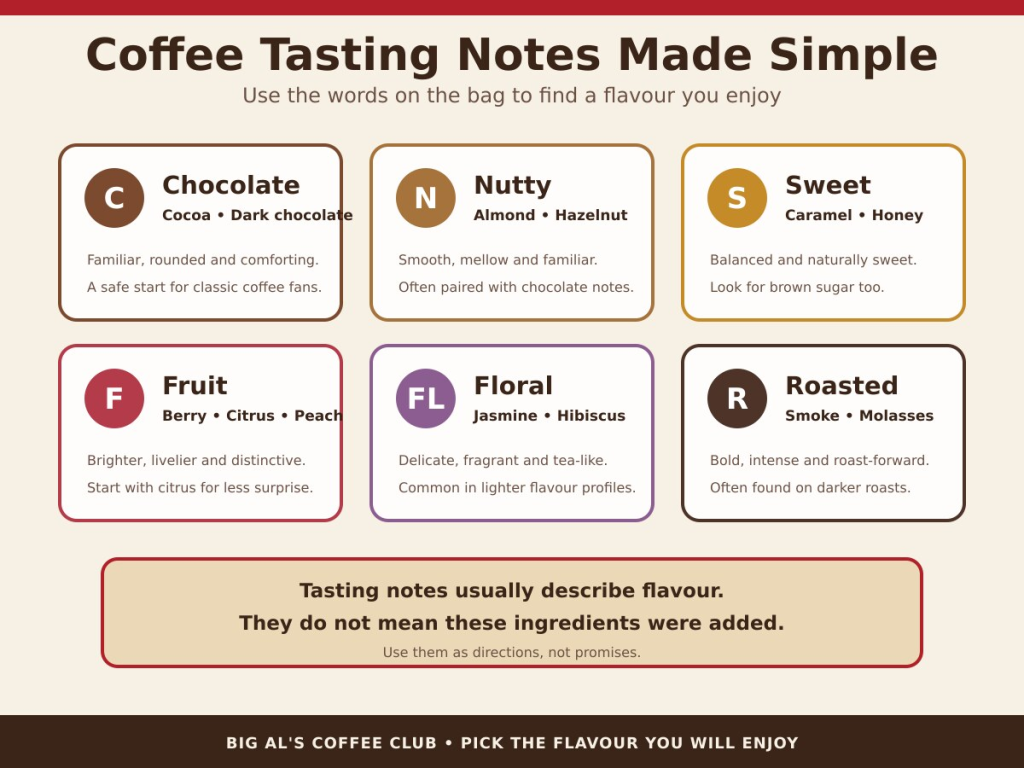
Coffee tasting notes describe aromas, flavours and sensations noticed during tasting. Words such as chocolate, blueberry or caramel usually do not mean those ingredients were added.
The Specialty Coffee Association separates descriptive assessment from personal preference. This distinction matters. Trained tasters might describe a coffee accurately while you still dislike it. A respected score does not overrule your tongue.
Use tasting notes as directions, not promises:
| Words on the bag | Likely flavour direction |
|---|---|
| Chocolate, cocoa, nuts | Familiar, rounded and comforting |
| Caramel, honey, brown sugar | Sweet and balanced |
| Citrus, apple, stone fruit | Brighter and livelier |
| Berry, tropical fruit, wine-like | Fruit-forward and distinctive |
| Floral, tea-like | Delicate and aromatic |
| Smoky, molasses, dark chocolate | Stronger roast character |
If you enjoy bold black coffee, chocolate, nut and dark caramel notes offer a safer starting point. If you enjoy brighter flavours, try citrus, berry or floral descriptions. A bag boasting fermented peach and hibiscus is not the cautious choice for someone who wants a traditional morning cup.
Roast Level, Process and Grind
Roast labels are not standardized across every roaster. One company’s medium roast might look darker than another company’s medium-dark. Pair the roast description with the tasting notes.
Light roasts usually preserve more origin character. Darker roasts emphasize flavours created during roasting. “Bold” does not provide a dependable caffeine measurement.
Processing offers another clue:
- Washed coffees often taste cleaner and brighter.
- Natural coffees often bring stronger fruit and sweetness.
- Honey-process coffees often sit between those profiles.
These are tendencies, not guarantees.
Check whether the bag contains whole beans or ground coffee. Match the grind to your brewer. Espresso, French press and drip machines need different grinds. Then use my guide to brewing the perfect cup of coffee at home.
How to Read a Coffee Bag Label for Value
Compare prices by weight, not by the number printed on the shelf tag. A $17 bag containing 300 grams costs more per cup than a $17 bag containing 340 grams.
Ask whether the label supports the price. Premium beans should offer more than “smooth,” “rich” and “luxury.” Look for a roast date, clear origin, useful tasting notes and a suitable grind.
Canadian examples help put these clues into practice. My Kicking Horse Coffee review compares three blends I have brewed and tasted. My Lavazza Coffee review shows how blend information and familiar flavour descriptions help with home brewing decisions.
My 30-Second Coffee Bag Check
When faced with a crowded shelf, use this order:
- Find the roast date.
- Read the roast level and tasting notes together.
- Check the country or region of origin.
- Confirm whole bean or the correct grind.
- Read the Canadian production wording.
- Compare the price per 100 grams.
Ignore fancy farm details until those six answers make sense. You are buying breakfast, not defending a thesis.
Frequently Asked Questions
Is a Coffee Roast Date the Same as a Best-Before Date?
No. The roast date records when the coffee was roasted. The best-before date estimates how long an unopened product should retain its expected quality.
How Long After the Roast Date Is Coffee Fresh?
There is no single deadline for every coffee. Many roasted beans taste best after a short resting period and during the following few weeks. Packaging, roast level, storage and personal taste affect the useful window.
Are Coffee Tasting Notes Added Flavours?
Usually not. Tasting notes describe flavours or aromas naturally perceived in the brewed coffee. Flavoured coffee is different and should identify added flavouring through its name or ingredient information.
What Does Single-Origin Coffee Mean?
It means the coffee comes from one defined source, such as one country, region, cooperative or farm. The exact scope should appear on the bag or the roaster’s website.
What Information Matters Most on a Coffee Bag Label?
Start with roast date, roast level, tasting notes, origin, whole bean or grind, bag weight and the Canadian production statement. Processing method and variety provide extra guidance.
Does a Maple Leaf Mean the Coffee Beans Were Grown in Canada?
No. Check for wording such as “roasted in Canada,” “roasted and blended in Canada” or “packaged in Canada.” Each phrase describes a different part of production.
How to Read a Coffee Bag Label Without the Nonsense
Knowing how to read a coffee bag label gives you a better chance of buying coffee you will finish and enjoy. Start with freshness, flavour, origin, grind and value. Leave the altitude and rare variety names for later.
Check the bag in your cupboard. Does it tell you when the coffee was roasted, where it came from and what it should taste like? If one detail is missing, decide whether the coffee in your mug fills in the blank.
As an Amazon affiliate I may receive a small commission on purchases.
Internal Links Used
- What Canadian-Roasted Coffee Means:
https://bigalscoffeeclub.com/coffee-tea/coffee-roasted-in-canada/ - Where Do Canadian Coffee Roasters Get Their Beans?:
https://bigalscoffeeclub.com/coffee-tea/where-do-canadian-coffee-roasters-get-their-beans/ - Brew the Perfect Cup of Coffee at Home:
https://bigalscoffeeclub.com/coffee-tea/brew-the-perfect-cup/ - Kicking Horse Coffee Review:
https://bigalscoffeeclub.com/coffee-tea/kicking-horse-coffee-review/ - Lavazza Coffee Review:
https://bigalscoffeeclub.com/coffee-tea/lavazza-coffee-review/
External Links Used
- Canadian Food Inspection Agency, date labels:
https://inspection.canada.ca/en/food-labels/labelling/consumers/date-labels-food - Health Canada, food date labels and packaging:
https://www.canada.ca/en/health-canada/services/general-food-safety-tips/how-read-food-date-labels-packaging.html - Canadian Food Inspection Agency, Canadian origin claims:
https://inspection.canada.ca/en/food-labels/labelling/industry/origin-claims - Specialty Coffee Association, Coffee Value Assessment:
https://sca.coffee/value-assessment - Fratello Coffee Roasters, reading a coffee label:
https://www.fratellocoffee.com/blogs/blog/how-to-read-a-coffee-labels - Rogue Wave Coffee, reading a coffee bag label:
https://roguewavecoffee.ca/blogs/education-journal/the-easy-way-to-read-a-coffee-bag-label
Please note: the opinions expressed in this post should never be construed as advice. The thoughts are based on my experiences and those of my friends and family. I am not a restaurateur or a formal barista. I just love coffee and love sharing what I learn with everyone. Please enjoy and share your favourites in the comments section.
Also: If considering a change in diet, exercise, nutrition and/or supplements, you must consult your medical practitioner to make sure that what you are about to embark upon doesn’t interfere with your current treatments.
Another note: on images, if the picture does not have my logo, I have downloaded it from either Unsplash or iStock. If you are looking for images, please check them out. I may from time to time use AI to create or enhance my images.
Note: If the image used in this or any of my other posts does not have my personal watermark of “Al Murray Photography”, then I have used one of my favourite image suppliers: Unsplash. There are tons of royalty-free images on this site. But I encourage you to tip the artist whenever possible to support the great work that they do. Also from time to time, I may use AI to enhance one of my own images or create a new image that helps support the post visually.