


Coffee for Older Adults: How Much, How Late and When to Choose Decaf
Coffee for older adults: a practical guide to caffeine amounts, sleep, decaf and questions for your pharmacist, with links to qualified medical guidance.
Table of Contents
Introduction
Coffee for older adults starts with three practical questions: how much caffeine are you drinking, when are you drinking, and how do you feel afterwards? There is no need to turn breakfast into a research project.
General adult guidance allows room for coffee, but your sleep, symptoms and medicines deserve individual attention. A smaller serving, an earlier finish or decaf are options to discuss when your usual routine stops agreeing with you.
I enjoy my coffee. I also know a late cup sometimes costs me sleep. My aim here is to help you ask useful questions and find qualified guidance.
Health note: I am a coffee enthusiast, not a doctor, pharmacist or registered dietitian. This article provides general information, not personal medical advice. Follow your healthcare team’s instructions, including any caffeine restriction.
Coffee for Older Adults: The Quick Answer
| Your question | A useful next step |
|---|---|
| How much am I drinking? | Record serving sizes and check available caffeine information. |
| Is coffee affecting my sleep? | Review afternoon and evening caffeine, and record your sleep. |
| Should I choose decaf? | Compare lower-caffeine choices while remembering decaf still contains some caffeine. |
| What about my medicines? | Ask your pharmacist about your complete medicine and supplement list. |
Coffee for Older Adults: How Much Caffeine?
Health Canada recommends a maximum daily caffeine intake of 400 mg for adults. The FDA’s caffeine guidance describes 400 mg as an amount generally unassociated with negative effects for most adults.
This is general adult guidance, not a personal target or an instruction to drink four coffees. Neither recommendation supplies a separate allowance for everyone over 60.
Individual sensitivity and medicines matter. Discuss a suitable amount with your clinician or pharmacist, especially if you already have symptoms or a prescribed restriction.
Start with your mug. Measure how much liquid your usual serving holds, then check the café or manufacturer’s caffeine information where available. Home brewing produces estimates rather than an exact caffeine reading.
Health Canada lists average amounts by drink and serving size. The FDA also notes substantial variation between products. Counting milligrams is more useful than assuming every ‘cup’ is identical.
Include tea, cola, chocolate, energy drinks and any caffeine-containing medicines or supplements in your record. Your second coffee does not know about your afternoon tea.
For brewing choices rather than medical advice, see my home coffee brewing guide.

Coffee, Sleep and Your Last Cup
Both Mayo Clinic’s caffeine guide and the National Heart, Lung, and Blood Institute’s sleep guidance identify caffeine as a potential sleep disruptor. The latter notes effects lasting up to eight hours.
An afternoon coffee therefore deserves attention if bedtime has become a staring contest with the ceiling. Finishing caffeine earlier is a practical option to discuss or try within your existing medical advice.
There is no guaranteed cutoff for every reader. Record your last caffeinated drink, bedtime and next-morning observations. Look for a pattern rather than judging one restless night.
Persistent sleep trouble deserves a healthcare conversation. Do not assume coffee explains every change in your sleep.
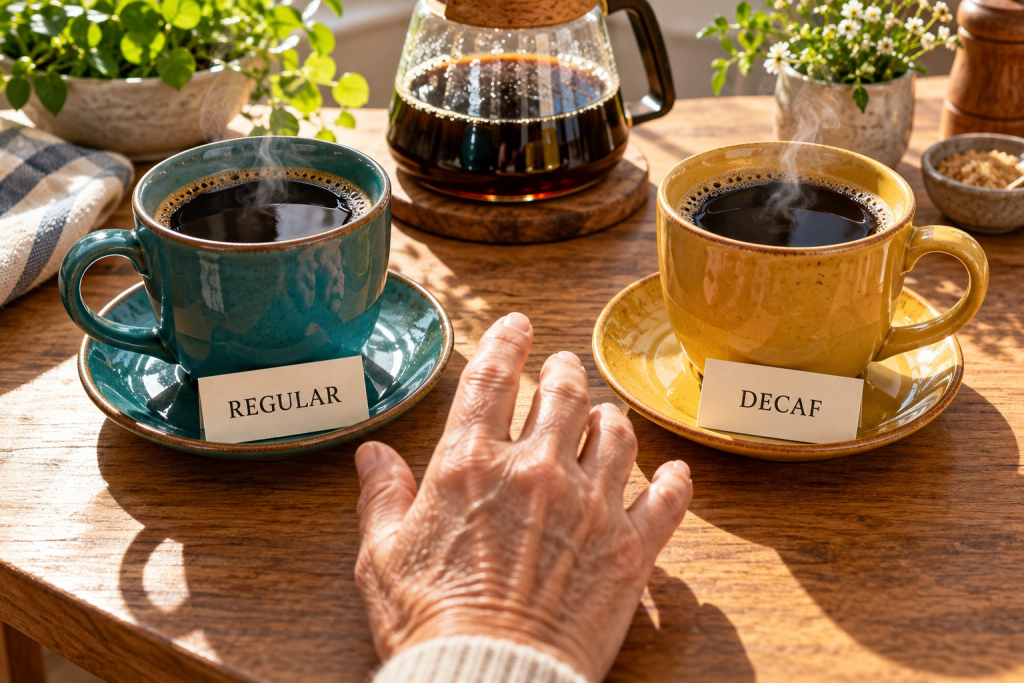
Regular, Half-Caf or Decaf?
Decaf offers less caffeine, rather than none. Health Canada and the FDA both report caffeine in decaffeinated coffee, with amounts varying between products.
Half-caf usually describes a mixture of regular and decaffeinated coffee. Check how the seller prepares the blend rather than assuming a precise caffeine dose.
The British Heart Foundation’s dietitian guidance on decaf discusses regular and decaffeinated drinks within a healthy diet. Read alongside the FDA’s explanation of residual caffeine when deciding what to ask your healthcare team.
For the coffee side of the decision, start with Decoding Decaffeinated Coffee. If convenience matters, Whole Bean vs Ground Coffee helps you choose a format for your kitchen.
My preference is to keep the enjoyable parts of the ritual: a favourite mug, a good flavour and five peaceful minutes. Decaf does not require a formal resignation from the coffee club.
If your clinician has advised avoiding caffeine entirely, ask whether decaf fits those instructions.
When to Ask Your Pharmacist or Clinician
FDA and Mayo Clinic guidance both flag sensitivity, symptoms and medicines as reasons to review caffeine intake. Examples of unwanted effects include poor sleep, shakiness, anxiety, stomach upset or a racing heartbeat.
Do not diagnose a new symptom from this post or change prescribed medicines yourself. Tell your healthcare professional what you drink, the amount and the timing.
- Does caffeine interact with any of my prescriptions, non-prescription medicines or supplements?
- Does my health history call for less caffeine than general adult guidance?
- Should I change drink timing, serving size or both?
- Would decaf suit my situation?
- Which symptoms need further assessment?
Bring your drink record and medicine list. Specific information gives your pharmacist more to work with than ‘a few coffees’.
A Simple Coffee Routine to Review
For coffee for older adults, I favour a small, manageable review over a cupboard full of wellness products.
- Measure your usual mug once. Note refills separately.
- Record coffee, tea and other caffeine sources for several ordinary days.
- Write down the timing and any symptoms, without deciding the cause yourself.
- If reducing caffeine, make a gradual change unless your clinician directs otherwise.
- Take unresolved questions to your pharmacist or clinician.
The FDA and Mayo Clinic recommend gradual reduction to limit unpleasant withdrawal effects. Abruptly stopping regular caffeine brings headaches or tiredness for some people.
Choose one manageable adjustment, such as a smaller serving or replacing a later coffee with decaf. Keep your notes simple. This is a coffee diary, not a second career.
Coffee for Older Adults: Common Questions
Is coffee good for seniors? General adult guidance leaves room for coffee, but does not establish the best choice for every older person. Your symptoms, medicines and healthcare advice take priority.
How many cups should I drink? Avoid a universal cup count. Serving sizes and caffeine amounts vary. Use available caffeine information and ask about your own limit.
Is decaf caffeine-free? No. Decaf contains some caffeine. Check product information and follow your clinician’s advice if even small amounts are a concern.
Should I start drinking coffee for anti-aging benefits? I would not use this article as a reason to start or increase coffee. This guide addresses everyday choices, not an anti-aging treatment.
Conclusion: Keep the Pleasure, Review the Routine
Coffee for older adults deserves a practical approach: know your serving, pay attention to timing and ask qualified professionals about individual concerns.
Enjoy the flavour and the pause in your day. There is no prize for finishing the pot.
Your next step: measure your usual mug and note when you drink your last caffeinated serving. Which part of your coffee routine would you review first?
Related Reading from Big Al’s Coffee Club
Medical and Public Health References
Read these sources for guidance from public health authorities and qualified healthcare organizations. They support the caffeine, sleep and safety information above.
- Health Canada: Caffeine in Foods
- FDA: How Much Caffeine Is Too Much?
- Mayo Clinic: Caffeine, How Much Is Too Much?
- NHLBI: Healthy Sleep Habits
- British Heart Foundation: Decaf Tea and Coffee
Medical Disclaimer
I am not a doctor, pharmacist or registered dietitian. This article offers general educational information and personal perspective. No individual medical assessment or professional medical review of this post is claimed.
Ask your clinician, pharmacist or registered dietitian about caffeine if you have health conditions, take medicines or supplements, or notice new symptoms. Follow individual medical advice over general guidance. Never change prescribed treatment based on this article.
Please note: the opinions expressed in this post should never be construed as advice. The thoughts are based on my experiences and those of my friends and family. I am not a restaurateur or a formal barista. I just love coffee and love sharing what I learn with everyone. Please enjoy and share your favourites in the comments section.
Also: If considering a change in diet, exercise, nutrition and/or supplements, you must consult your medical practitioner to make sure that what you are about to embark upon doesn’t interfere with your current treatments.
Another note: on images, if the picture does not have my logo, I have downloaded it from either Unsplash or iStock. If you are looking for images, please check them out. I may from time to time use AI to create or enhance my images.